Monday, 12 August 2013

Gadding about at Underscar.

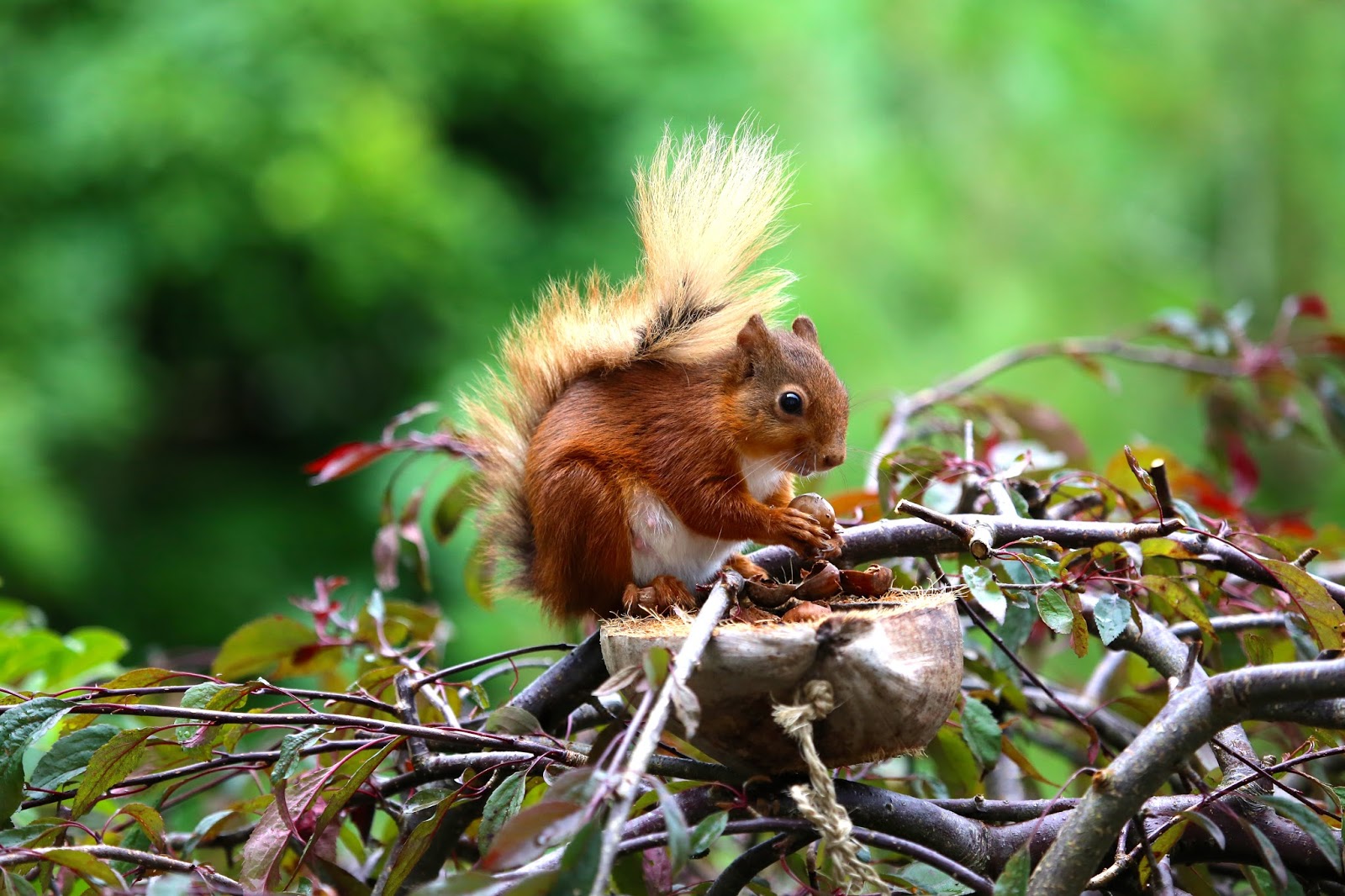
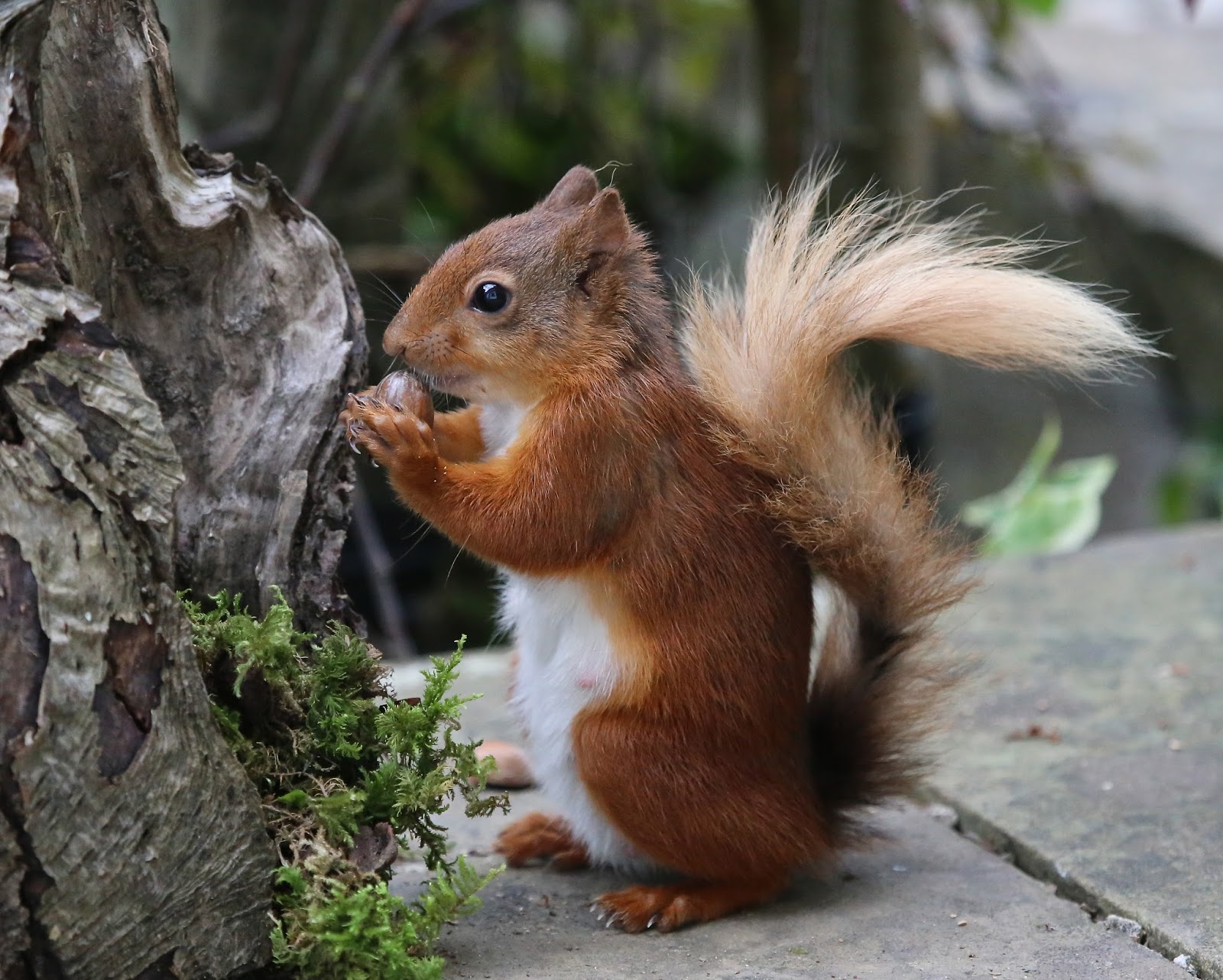
       The red squirrels leave the wooded slopes below Skiddaw to visit the Underscar timeshare lodges.


       Studies have shown that the main reason why any squirrel stirs from its drey is to find food.


       They do sundry other activities whilst out and about,including mating, grooming and falling asleep, but few things apart from food occupy much of the squirrel's time.


 Squirrels are active whilst they are hungry, and unless there is something else to keep them occupied, like a mate, they would remain in their drey all day.


        In summer the days are long, and food may be scarce. A squirrel's stomach isn't very big, and the food available at this time of year is often bulky and of low nutritional value, such as shoots, buds and bark. The result is a pattern of activity which starts at dawn.Then one or more siestas as the squirrel digests a stomachful of food before resuming the search.


                                             Underscar squirrels enjoying hidden hazelnuts


        I got up with the squirrels yesterday (11th August 2013) at 6am, and I was still watching them foraging until the last vestiges  of light. These photos were all taken over the last week, the hazelnuts in the feeders are so welcome for the squirrels at this time of year to supplement their diet.


Wednesday, 31 July 2013

Poppy Stopping Moments.

   Wild poppies turn ordinary fields into beautiful landscapes.Driving past this one on Bempton Lane,near Bempton village in East Yorkshire,made me stop several times to take photos.


Large crinkled,tissue-paper-like flowers looked to have four vivid red petals on closer inspection.


The poppy flower is held aloft by strong, curved hairy stems. The hairs are to deter predators. I have also learnt that the hairy stems taste strange to predators!

This next photo was taken in the evening. Closed petals looked as if they were in prayer.


The three stages in a common poppy flower are:   Bud    Flower    Capsule      


My favourite poppy images are always the ones where the central rings of black stamens start to produce their pollen.


After a few days the pollen has started to fall on the petals as insects have carried it away.


The poppy pods that grow after the bright flower petals fall off look like little faces that have sprouted a flat top hair cut.


The last time I drove past the poppy field I couldn't resist one last photo. It was just in time, as two days later the farmer had cropped the field.


Tuesday, 2 July 2013

Wandering teenagers.

   July is the month when many of this year's hatchlings make their first strides (and flaps) into the wider world. I was able to catch up with two juveniles in our garden this week.


   The longer feeder is always a favourite of the Great Spotted Woodpecker during the year.


   So I was thrilled when the two juveniles also arrived on the scene. One was very well behaved staying safely in the trees above the hedge. The adult went to and fro feeding it.


   The other juvenile had a desire to explore, coming out onto the top of the hedge, perching on tree stumps protruding from the hedge and hopping onto the bird house roof. The adult carried on busily feeding both juveniles.


   Juvenile Great Spotted Woodpeckers are similar to adults but have two main features which, should age them immediately. Firstly the crimson on their under tail is a weaker pinker colour than an adult. Secondly and unmistakably, the crown is red, not black as it would be with an adult.


    As the parent initially helps with the feeding a good comparison of colours can be made. The male adult has a small red spot at the nape of his neck. This is absent in this female. Both male and female help with the feeding.


    The next day one of the juveniles had completely mastered selecting food from the feeder by itself.


    It stayed at least 5 minutes before it was off making a break for freedom.


Wednesday, 19 June 2013

Love On The Water.

Since the beginning of April I have visited Bretton Country Park, West Yorks, every 10 days, to observe the resident Great Crested Grebes. 


Walking down to the hide on the Upper Lake I always experience a terrific feeling of expectation.You enter the hide from a pathway at the back of the hide. Once inside you have full lake frontage.


A pair of Great Crested Grebes have nested in the middle of the lake. It is possible to take some distant shots from the hide.


Before the breeding season both sexes acquire conspicuous and beautiful dark head plumes which are erected during the height of the courtship display.


The courtship display involves head-shaking, diving, fluffing out the feathers in the so- called 'cat' display, and presenting each other with water plants while raising from the water breast to breast.


At the end of April on a regular visit I was dismayed----they had abandoned their nest.Not such a surprise I suppose as in the previous visit I had seen a mink in the water around their nest. Predation of eggs must be a real threat .

Nature fights back as on the next visit they had sited a new nest further up on the lake---a raft of water weeds attached to reeds to stop it drifting away.


This visit I was fortunate to witness the Great Crested Grebes mating ritual. She was 'in position' for some time before the male took the hint. Then it was all over very quickly.


My visit yesterday on a hot June day saw the grebe still on the nest. Its partner was away up the lake diving for a meal.


I so look forward to visiting next time to see if I can spot the chicks. Fingers crossed!

Thursday, 23 May 2013

Feather Fascination.

       Around 8,000 pairs of gannets return every year to RSPB Bempton near Flamborough on the East Coast.Gannets mate for life.They are renowned for their faithfulness,usually returning to the same nesting site with the same partner.

     I was thrilled to see this young gannet with its feather present ready to take to its intended.Young gannets are often seen presenting each other with flowers and feathers.

     For a few moments i watched as it ruffled up its own feathers carefully still clutching the present.Obviously this gannet wanted to look its best on presenting the gift.


                      Another gannet sneaks behind to watch the action.


         Not wanting to waste any more time it flies off to present its gift.


      We returned the next day to the same spot on the cliffs.The weather conditions had changed dramatically.I found it difficult to hold my camera against the wind.However the gannets were enjoying a spot of formation flying.


       Whenever it got very gusty they simply put up their tail feathers.What a brilliant rudder.

Thursday, 2 May 2013

East Coast Barn Owl Encounter.

Looking pleased here as we were tipped off today as to where the barn owl would be hunting.


First task was to try and conceal myself by trying to break up my outline with camouflage.


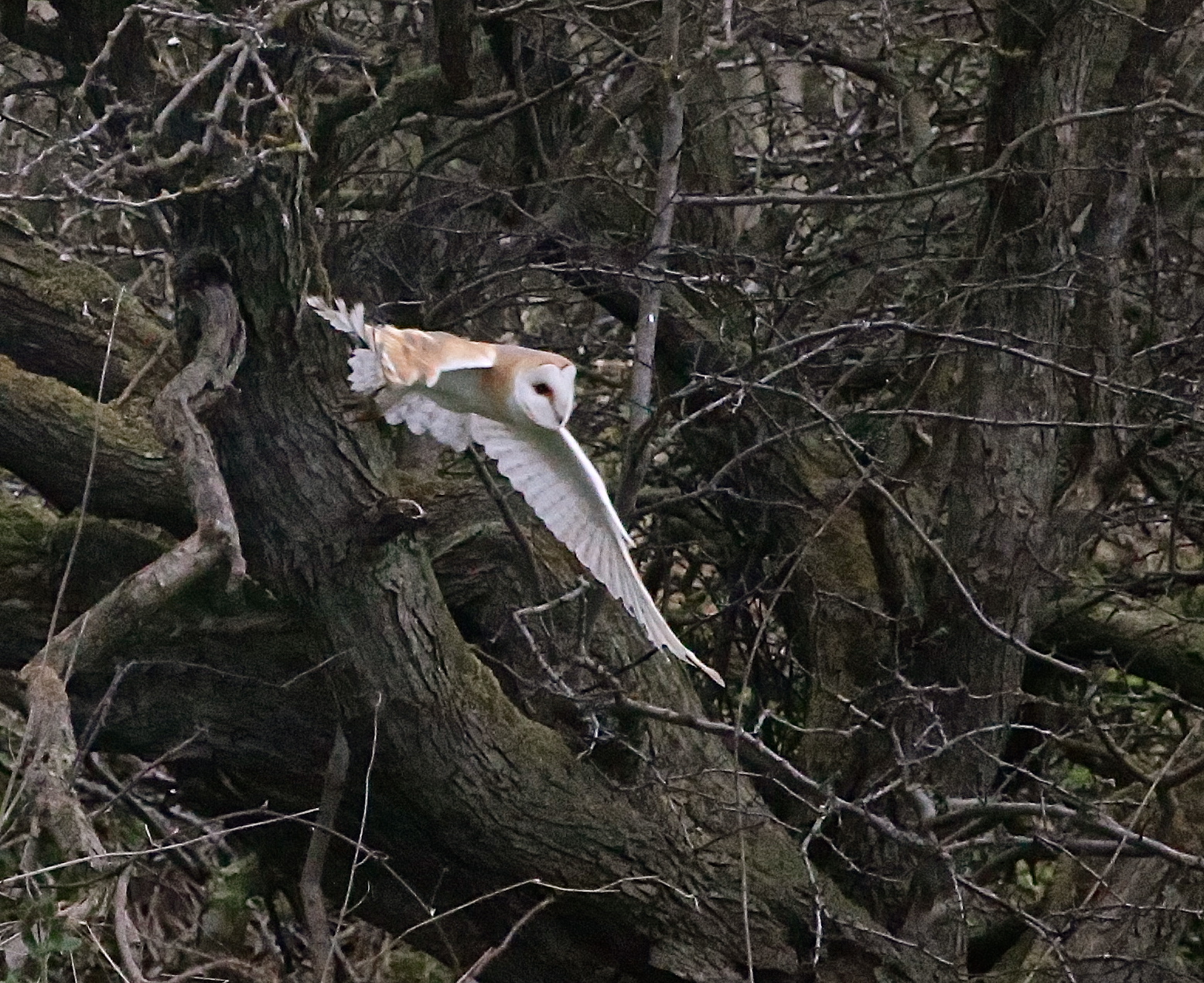
It was breathtaking as the barn owl started to fly towards me and start hunting on the banking.It looks as if they can feel the wind under their wings.


Hunting was the one thing on this barn owl's mind.After a few minutes it moved on to other fields.

Waiting patiently, it returned about an hour later.This time it seemed intent on finding a suitable post to spy its prey from.


Exceptional hearing is the barn owl's most important hunting tool.One ear is slightly higher than the other.So the owl can calculate the exact position of the sound source. A single barn owl, on average, captures 2,000 mice and voles  every year.


It's heart shaped face and snowy white underparts are stunning to observe.It was recently voted Britain's favourite farmland bird.It lives for around 4 years.It's presence is heard by screeching,hissing,yapping and snoring.


After watching for about 15 minutes where it was post hopping, it launched off into a nearby dell which was quite woody.I felt this background gave it a mystical quality.